

Why we don’t have a single bone of Mary
2026›08›16 · 5 min read

When I worked for TV, during my apprenticeship, I learned a maxim that truly impressed me. I am even teaching it to my children.
The maxim is: Entschuldigungen werden nicht mitgesendet. That roughly translates to: “Excuses don’t air,” or: “We won’t broadcast your excuses for what failed. Just get the film done.”
Well, this isn’t TV. This is (a text spoken on) YouTube. “You” in “YouTube” here means me. And what may sound like an excuse is the confession of my failure. Can you tell I believe in the healing power of confession?
Well, yesterday was the 15th of August. And everybody knows: that’s when you commemorate the Assumption of Mary.
Yesterday I had gotten up early, at 5 a.m.; I planned to finalize and record my thoughts about that particular, beautiful day.
I failed. I didn’t record. So let me summarize what I meant to.
The Assumption of Mary, I meant to say, is the dogma that Mary, the mother of Jesus, at the end of her earthly life was taken into heaven whole, soul and body.
I love this dogma, for many reasons.
One reason is that it is very logical. Let me explain, real quick. You know what “relics” are. Physical objects with a connection to a saint or even to Jesus himself.
The closer a saint’s relic is to him or her, the higher it is regarded. The closest possible for a relic is to be a literal part of the body.
No, relics shouldn’t be traded, but relics can be quite profitable. Cathedrals were built around relics. The spiritual pull can create local economies and then sustain them.
So the absolute super-relic would be a broadly accepted solid body-part of Mary, like a bone.
Of John the Baptist we have no fewer than four places holding skull-fragments. We have the whole bodies of several saints. Catherine of Bologna has been sitting in her chair since 1529.
But of Saint Mary we have not a single bone. We have Mary’s girdle and tunic. We even have her tears and, yes, her milk. Actually even some hair. But of the bones and organs not even the small toe. Let alone the heart, which would be the absolute super-mega-relic. People would come from far and wide, and from all corners of the world.
Why?
Because Mary was assumed into heaven, soul and body. That was believed since at least the fifth century. It was defined as dogma in 1950 by Pope Pius XII. Note that defining doesn’t “make it true.” It delineates definitely what always was true.
And that is the logical beauty in the dogma of the Assumption of Mary. The logic of a conclusion from absence.
And there is another reason why I love this dogma especially. It is an old truth, protected and passed on by tradition. The same rock on which the Bible, the Gospel, and the Old Mass stand.
But yes, there is a big question about the Assumption of Mary. Not whether it happened. It did. Tradition and Logic vouch for it.
The question is: Do I—do you—truly believe that I will one day, soul and body, be with God, just like Mary already is?
I am currently in Toledo, Spain. Among my excuses for not recording this yesterday is that after I went to the very festive Mass, I simply couldn’t get through back to the apartment. And I couldn’t record this anywhere in town, as the city was packed. People came from far and wide, from all the surrounding cities.
In Toledo the feast of the Assumption of Mary is co-celebrated with the feast of the Virgen del Sagrario, the Virgin of the Tabernacle, the patroness of the city. It is a huge celebration, well into the night.
Yet I wonder: If all of us there believe that we believe this dogma, where are they all on a regular Sunday, when the church has “only” the body of Christ to offer? Today, the very next day, is a Sunday. The Tabernacle will still be there; most of the crowd will have moved on.
You know, this maxim that excuses don’t air, it might become quite relevant when all our unforgiven and hence dirty laundry is aired.
Well, as Our Lord promises, in the Gospel of John:
Wonder not at this: for the hour cometh wherein all that are in the graves shall hear the voice of the Son of God.
And they that have done good things shall come forth unto the resurrection of life: but they that have done evil, unto the resurrection of judgment.
– John 5:28–29
And yes, that is a message of hope. It should be again broadcast wide and far, to all corners of the earth.
Keep writing, Wegner!
Writing these essays is only possible with your support. Become and stay part of my work!
Please choose your voluntary reader contribution:
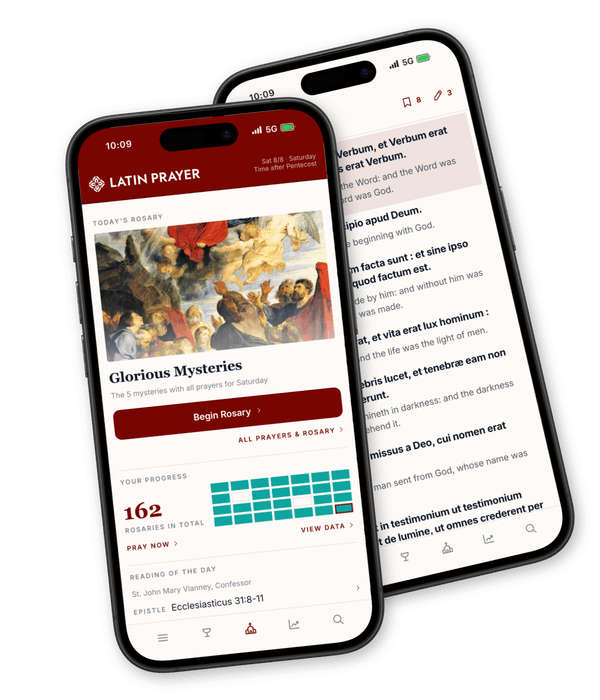
Latin Prayer: my app for praying in Latin
The Rosary, the Mass, the Vulgate and the prayers of the Church — Latin and English side by side, line by line, much of it with audio, so you can hear how it sounds. Free, no ads, for iPhone and Android.
Email Notification
When there’s a new post, you’ll get a short email — at most once a day. Free, and you can unsubscribe anytime.
Der Essay Why we don’t have a single bone of Mary von Dushan Wegner ist auch online zu lesen: https://www.dushanwegner.com/essays/assumption-of-mary/, und auf dushanwegner.com finden sich noch viele weitere Texte, Bücher und sogar T-Shirts zum Thema!
