
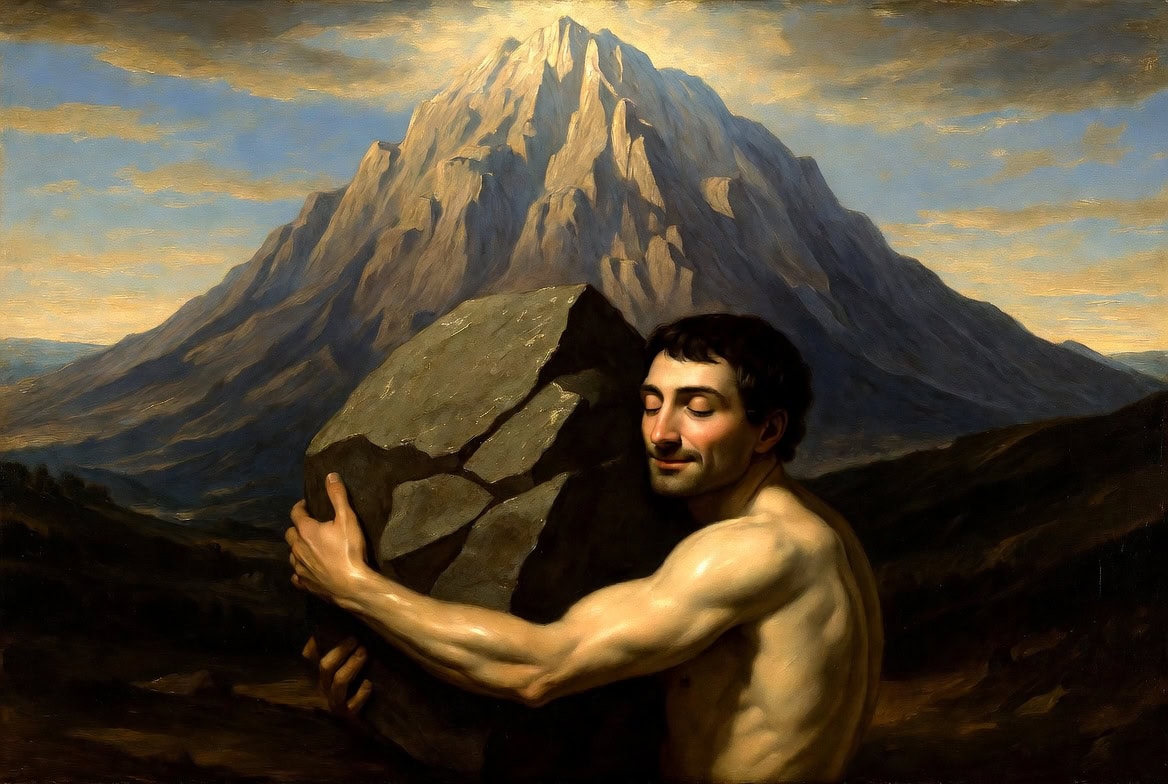
»The gods had condemned Sisyphus to ceaselessly roll a boulder up a mountain, from whose summit the stone would roll back down of its own accord,« writes Albert Camus, as is well known, and: »They had thought, with some justification, that there is no more dreadful punishment than futile and hopeless labor.«
I personally would have found it helpful, at this early point in that essay, to define what exactly is meant by labor (travail).
Is an occupation labor when it happens against one’s will?
Is the phrase »futile and hopeless labor« a white mold? A pleonasm, because labor is necessarily futile and hopeless? (Is Camus thereby describing his own labor? Ah, too simply thought.)
I myself would understand labor rather as productive occupation, and by no means does everyone who goes to work and is occupied there actually labor there too (in my sense). Indeed, the »labor« of many a bureaucrat above all hinders and prevents the actual labor of those really laboring. But wherein lies this actuality and reality of labor?
But, ah, ad fontes!, and the source is The Myth of Sisyphus by Camus, and his »labor« famously consists of rolling the stone up the mountain, again and again.
I myself – and who has not? – have more than once compared my actual and real writing to Sisyphus’s occupation.
»Let go, Sisyphus!« (German), I called out in 2018, and did not follow my own advice but rather, it seems, called back: »What else am I supposed to do? I am, after all, a stone-roller!« (Let it be said in advance that resigning oneself is at least conceptually not identical with being happy.)
In 2020 I observe: »Sisyphus has sat down on the sofa« (German). It was amid a certain global »event«, and we were sentenced to sitting on the sofa. With pitiable naivety, a Wegner six years younger closed that essay thus:
We have all earned a little sofa time, Sisyphus too and especially – but soon, very soon, let us rise again and roll the stone back up the mountain!
In 2025, finally, I appealed once more to our perseverance: »One fights, one fights« (German)!
As if to refute, quite practically, that insight always grows linearly with each step forward along the timeline, the essayist droned on as follows:
We must, as is well known, imagine Sisyphus a happy man, for Sisyphus is a victor, again and again, and indeed each time he resolves anew to push the stone up the mountain.
No, no. Sisyphus would rather have stayed sitting on the sofa. He would rather have stayed on the sofa and thought. Thought in that manner in which the thinker, in his thinking and as a result of his thinking, changes his thinking – and thereby himself.
That is, I think today, what I painfully missed all these years in Camus’s Sisyphus: Sisyphus has all the insight, yet the daily »labor« evidently does not change him.
That is remarkable (to put it politely).
We know, of course, the famous finale of The Myth of Sisyphus: »The struggle toward the heights is itself enough to fill a man’s heart. We must imagine Sisyphus a happy man.«
Yes, it is true that the struggle toward the heights can »fill a man’s heart«, that is: can with some plausibility be called »happiness« (bonheur).
But is Camus thereby precise enough?
Is the struggle of Camus’s Sisyphus really a »struggle toward the heights«? No? A summit implies a goal, and where one cannot reasonably assume the goal will be reached, then mere repetition is precisely that. For Sisyphus, the mountain has no summit.
Just recently, in »Tickets, slow and fast« (German), I wrote:
The difference between madness and mastery lies in the honest answer to the question of whether one can justifiably assume that repeating the same action will yield new and better results.
Camus’s Sisyphus does not grow through his »labor«. He resigns himself to the aimlessness. Any bureaucrat who at least works toward his retirement has more goal in his labor than this Sisyphus.
This Sisyphus sees the stone roll down the mountain, and he is aware in that moment of the futility – yet he draws no consequence. Is his condemnation, like the hardened heart of Pharaoh (Exodus 9:12) or the sin against the Holy Spirit (Mark 3:29), an inner one?
Not every trauma traces back to a past event. My trauma stems from the possible failure of states yet to come. I circle it in the metaphor of the mountain without a summit. (See on this »You did not know it was the summit« (German), »The mountain has no summit« (German), »Without a concept, only »Oh!«« (German) and a few unpublished manuscripts.)
What, then, should Sisyphus do?
Sisyphus should take a lesson from Alexander the Great and cut through his own knot with one bold stroke.
»Yes, I am condemned to roll the stone up«, Sisyphus should say, »but I will not do it.«
That was the wicked trick played on Sisyphus. He was not condemned to roll the stone up. He was condemned to believe that he was condemned to roll the stone up – a stone that would never arrive at the top, for to keep Sisyphus thus from the summit was the essence, purpose, and sole task of this very stone.
Sisyphus should say: It is against the stone’s nature to reach this summit.
But I myself am driven hard to be at the summit!
So I let go of the stone (German).
And I climb.
Not the stone was my condemnation – my excuses condemn me.
The stone was my excuse not to follow the call of the summit.
Keep writing, Wegner!
Writing these essays is only possible with your support. Become and stay part of my work!
Please choose your voluntary reader contribution:
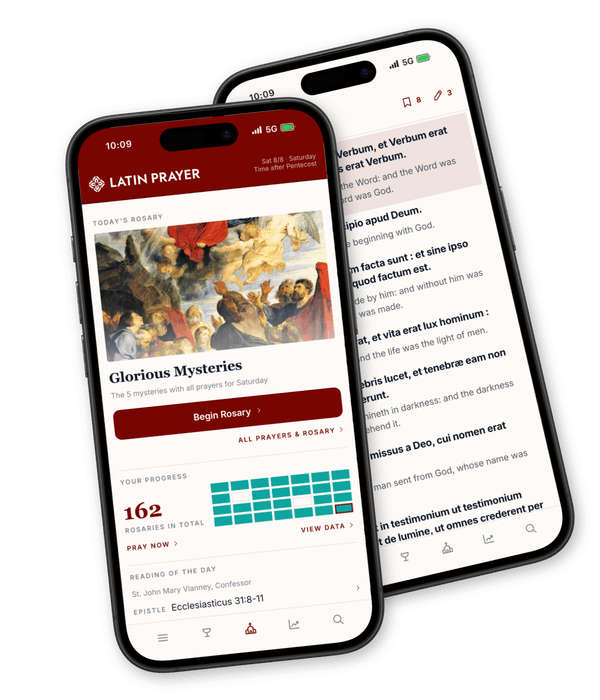
Latin Prayer: my app for praying in Latin
The Rosary, the Mass, the Vulgate and the prayers of the Church — Latin and English side by side, line by line, much of it with audio, so you can hear how it sounds. Free, no ads, for iPhone and Android.
Email digest
When there’s a new post, you’ll get a short email — at most once a day. Free, and you can unsubscribe anytime.
Der Essay Condemned to believe himself condemned von Dushan Wegner ist auch online zu lesen: https://www.dushanwegner.com/essays/condemned-to-believe-himself-condemned/, und auf dushanwegner.com finden sich noch viele weitere Texte, Bücher und sogar T-Shirts zum Thema!
