

I’m so happy! I want to tell you about Lucy and me — and of course about our Eskimo baby. The twitching in my right eye is a bit annoying, but otherwise Lucy and I are doing wonderfully. I feel like I could burst from joy and excitement!
But you wouldn’t understand anything if I just told it all out of order, so let’s start at the beginning.
It has to do with the AFGSO.
It was the year 2035, and for five years we had owned nothing and were happy. Those who weren’t happy were taken by the police and injected with a Happy Booster — then they were happy. Or dead. But no longer unhappy, and that was what mattered most.
Lucy and I were happy, and that’s exactly why we wanted to move into an apartment together — maybe even one with a window!
Lucy and I had saved up some money, and then we made an appointment with the AFGSO.
An AFGSO employs FGSO consultants. We sat across from ours, comfortingly separated by his desk, and he asked us the usual questions — about our income, our qualifications, our current sexual organs, and so on.
Ever since the government passed the “Law for Fair Housing” in 2025, citizens no longer choose their living space themselves, because choosing for oneself is unfair.
Housing was now allocated according to the formulas and weighting of the Housing Fairness Table.
That meant, however, that without a clever FGSO, Lucy and I had little chance of getting a shared apartment with a window. Justice sometimes needs a little help to truly be just — and that’s what FGSO is for.
Lucy and I both had far too ordinary professions to hope for housing fairness in that regard.
I trained language models in the claims processing department of an accident insurance company. On the side, I wrote short stories and notoriously unfinished novel fragments. Lucy maintained the gender-neutral sex robots in one of the new brothels China had recently used to expand into Western cities.
Neither Lucy nor I wanted to become journalists, protesters, or park drug dealers. So we needed professional help to find a shared apartment with a window — and that’s why, in 2035, we finally booked the services of the AFGSO.
It’s not like we hadn’t tried to optimize our FGS on our own! Many young and inexperienced people try that at first — unfortunately, so did we.
Back in 2032, Lucy and I were still freshly in love. We wanted to go on vacation together. Not just virtually, as was being touted as the new standard, but for real — with an airplane, a hotel, and sparkling wine for breakfast.
When booking the trip, we had to check which authorization we intended to use to go on vacation.
There were still spots available in the travel quota for gay couples aged between 25 and 30.
That sounded doable.
We checked the corresponding box, and Lucy identified with the required gender, and I with the required age. The travel agency automatically registered our new identification with the Department of Flight Fairness.
We went on vacation and didn’t think much of it.
We didn’t expect any negative consequences from our spontaneous identification. Our impression was that, in practice, only officials, journalists, and professional protesters could travel without identity changes — and those people didn’t vacation in the same modest resorts as we did anyway.
But there were some details and interactions I hadn’t considered — or simply hadn’t known.
For example, a few months earlier, to get approval to buy a washing machine, I had identified as a Nigerian Pentecostal pastor who needed the water-consuming and therefore environmentally harmful appliance to wash his church uniform. It hadn’t even been my own idea! That electronics store alone sold ten to fifteen washing machines a day to Nigerian Pentecostal pastors, at least according to reports sent to the Department of Water Fairness.
But when the Fairness Authorities found out that Lucy and I were now a gay couple aged 25 to 30, we apparently fell into an FG category I hadn’t known existed.
The first resulting surprise was actually quite pleasant: we were unexpectedly granted permission to buy one-eighth of an automobile. We weren’t interested in such luxury, nor did we have the money for it, but when we declined, we received a very welcome climate bonus instead.
Had we had that money earlier, we might have bought the eighth share — but then we would have… ah, fairness is complicated sometimes. Good thing our government takes care of it.
The mills of justice grind at unpredictable speeds — sometimes in seconds, sometimes painfully slowly like the glaciers of old — but they do grind.
My employer had previously gotten approval for my employment within the reeducation program for “Involuntary Celibates,” meaning men who lived “involuntarily celibate” lives and were therefore considered a fringe group (though one that needed reeducation — usually into “voluntarily celibate” men).
My employer had little choice but to register me that way, since there were few ways to employ people of my biological sex, and he badly needed my skills.
Maybe he told me about this extra approval, maybe not — I don’t remember. But by carelessly checking that Lucy and I were a gay couple when booking the vacation, I legally fell out of the “Incel” category — and that was a problem: the Fairness Authority threatened to revoke my employer’s authorization to employ me as a merely biological man.
Hardly had Lucy and I returned from vacation when my employer summoned me to the large conference room.
My direct supervisor was there, as well as the procurator and a psychologist trained in FGSO.
In a draining conversation, they uncovered that I suffered from a premanifest dissociative identity disorder. They would use that to justify authorization for my continued employment.
They pleaded with me not to engage in any further FGSO on my own without professional guidance.
And that’s why Lucy and I, in 2035, sat with the professional AFGSO to get advice on how to obtain a shared apartment.
“AFGSO” stands for “Agency for Fringe Group Status Optimization.”
Anyone who wants to get ahead in life must have their fringe group status reviewed — at least annually, preferably monthly — and adjusted as needed.
Do you want to apply for a subsidy available only to certain disadvantaged groups? You’d like an apartment with running water? Approval for a flight vacation? You even want to enroll your child in one of those luxury schools that guarantee no more than one seriously injured student per week and a maximum of three deaths per year?
For all that, you must identify as a member of a disadvantaged fringe group — one that actually provides the intended advantage while not contradicting membership in another group.
It’s not easy, but it can be worth it.
Our AFGSO consultant once joked: “Tell me how disadvantaged you are, and I’ll tell you how far you’ll get in life!”
Our first consultation with AFGSO was extra thorough — and, I must admit, exhausting.
The expert reviewed all of Lucy’s and my previous identities, as far as I could remember them. Then we drafted various future plans, including possible further identity changes.
It was fascinating to watch a professional at work! He saw and understood possibilities and interactions that would never have occurred to me!
For example: through a loophole in the Law for Transport Fairness, anyone identifying as a “laid-off coachman from the German Imperial era” was entitled to a “coachman’s pension” — a small stipend, but still money. However, they had to identify as at least 140 years old, which, due to the Law for Healthcare Fairness, excluded them from all costly medical services. (We weren’t former coachmen, and we didn’t want to identify as such.)
Our AFGSO consultant found a suitable path for Lucy and me to be assigned a lovely apartment.
Ah, how happy we were when, thanks to AFGSO, we moved into our first shared apartment — with a window!
The window couldn’t be opened, but when I crouched right in front of it and tilted my head back, I could even see the edge of the sky!
I couldn’t thank AFGSO enough. The consultant had truly thought of everything and had prepared me for what I would have to give up.
I had to return the washing machine and wash clothes by hand again, since I no longer identified as a Nigerian Pentecostal pastor. I now identified as an orthodox rabbi.
But the apartment was worth it, and Lucy suddenly began baking delicious challah every week.
The building manager announced one day that we were getting new neighbors — two blind Senegalese people.
And the next day they’d already moved in. Wonderful people! Their names were Magda and Alexander Eisenstein. When they saw us, they greeted us cheerfully with “Zdravstvuite!” — which means “Hello!” in Senegalese.
We arranged to meet the following Friday evening. We talked about ourselves, and Magda asked whether Lucy or she would light the candles. I didn’t know what she meant — ah, there was still so much to learn about Senegal!
By regularly optimizing your fringe group status, you keep meeting new people — even just by looking in the mirror.
And AFGSO, of course, is also quite practical — let’s be honest! If you don’t optimize your fringe group status, you’re missing out on opportunities, especially in our strictly tolerant world.
Unfortunately, you can’t yet rely on your optimized fringe group status everywhere in the world.
In less progressive countries — those where people still take themselves seriously or simply have their senses about them — FGSO sadly isn’t as accepted as it is here.
And even the ultimate fringe group, “the one percent,” may push this progressive way of thinking worldwide, but they react surprisingly coldly if you identify as one of them and try to attend their parties. (Go into a bank and identify as a billionaire wanting to withdraw his money — shocking how backward even bankers with ten tolerance flags over their doorways can be!)
But yes, overall, I’m very satisfied with our AFGSO’s work — and, of course, with our apartment.
My relationship with Lucy is livelier than ever! Yes, Lucy is my daily ray of light, and without her, I’d be alone.
Sometimes people ask me who this Lucy is that I’m talking about. But my employer says I shouldn’t think about questions concerning Lucy’s existence if I want to keep my job. So I won’t do that here, either.
It’s enough for me that Lucy and I are happy. We’ve been assigned an apartment for now, matching our current fringe group status, and we own nothing — and we are happy.
Lucy and I are so happy that we’ve been working for some time on adopting a child.
We asked our AFGSO consultant which identity would allow us to adopt a child without losing our apartment or our jobs.
After reviewing our case and the current situation, he recommended that we identify as Eskimos.
Of course, we were glad to do that!
So it would be an Eskimo baby — just for Lucy and me!
Today we got to see our baby for the first time, our sweet Eskimo baby.
The boy is biologically a bit older than I am, two heads taller, and had been working very hard until recently — though I don’t know at what — but he identifies as an Eskimo baby.
So now we’re a family!
Lucy and I take turns changing our Eskimo baby’s diapers, as modern parents should.
We have nothing but our baby, each other, and of course our assigned apartment — and we are happy.
To be safe, Lucy and I refreshed our Happy Boosters. Since then, my right eye twitches a little, but that’s not so important.
We are happy, and we have nothing — and that’s what matters most.
Weiterschreiben, Wegner!
Das Schreiben dieser Essays ist nur mit Ihrer Unterstützung möglich. Werden und bleiben Sie Teil meiner Arbeit!
Bitte wählen Sie Ihren freiwilligen Leserbeitrag:
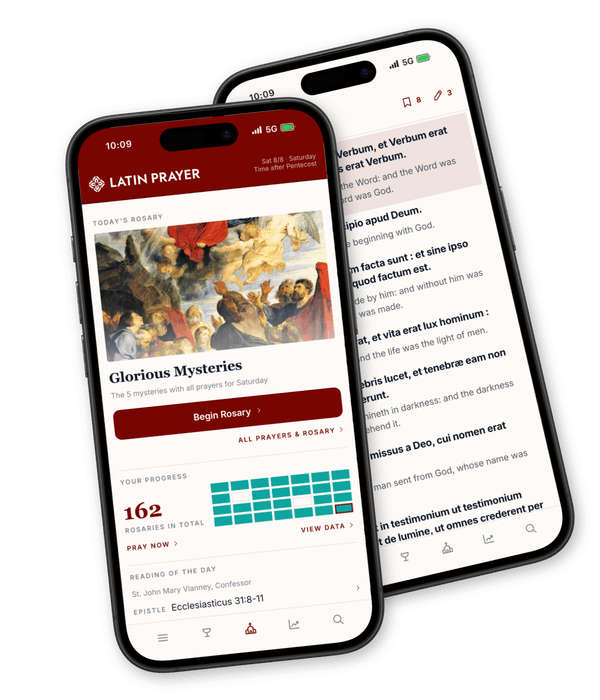
Latin Prayer: my app for praying in Latin
The Rosary, the Mass, the Vulgate and the prayers of the Church — Latin and English side by side, line by line, much of it with audio, so you can hear how it sounds. Free, no ads, for iPhone and Android.
Email digest
When there’s a new post, you’ll get a short email — at most once a day. Free, and you can unsubscribe anytime.
Der Essay Lucy, me, and our Eskimo baby von Dushan Wegner ist auch online zu lesen: https://www.dushanwegner.com/essays/lucy-me-and-our-eskimo-baby/, und auf dushanwegner.com finden sich noch viele weitere Texte, Bücher und sogar T-Shirts zum Thema!
