

- English
- German
Some die at 20 or 30, but are only buried at 70 or 80, or so I’ve heard.
No, we are not describing rotting bodies here. On the contrary: some who are internally dead for an entire lifetime can smell just fine. He or she can even be pleasant to look at. He can — and likely will — enjoy a fantastic career. He can gain prestige (especially prestige among other early-dead). And when the early-dead person is finally buried later on, a gravestone will be erected with his external life dates on it. (Although, in our day and age, when nothing means anything anymore, we prefer to cremate one another. If the dead are truly dead, what do we need gravestones for?)
To die young and be buried old means this: someone gives up far too early what constitutes soul and life and being human. He functions. A zombie with a tax number. (Or, as Kraftwerk once sang; see YouTube: “Wir sind die Roboter.” The term robot as a working human machine is, as is well known, derived from the Czech-Slavic word robota, meaning work. It was invented by Josef Čapek, a Czech, but systematized by Germans and later Americans. Similar to Protestantism. Both are reaching their limits in these decades. Both are being led back to their origins. In the one case, the original lies in a past that reaches into the present. A renaissance of rebirth. Panem nostrum, at best quotidianum. Old form instead of re-form. And in the other case, the future is beginning today—the future that was invoked for so long that the invocation itself produced retro-futurism. The human robot, always only an interim robot, finally replaced by the robot robot. For, as Josef’s brother wrote: “práce se nesmí zastavit”—work must not come to a standstill.)
But is it possible to escape early death by the skin of one’s teeth?
Yes, it is possible, and it has been done successfully by more than one mortal, and it is not even very complicated. The difficulty lies in distraction, seduction, lies.
It was not necessarily the promise of the knowledge of good and evil that was the serpent’s lie, but rather: “No, you shall not die the death”; see Genesis 3:4.
Ask a person: What would you say if you were a wise man, a philosopher, a selfless one? Ask yourself, and surprise yourself with your answer. A human knows what the right thing is (what “is to be done”), as long as a spark of life still flickers within him.
That, too, lets us die at 20 or 30: that we know what is right, yet kill that very knowledge within ourselves.
The other cause of that early death sounds paradoxical at first: we die early because we wanted to cling to life.
“For whosoever will save his life shall lose it,” the Bible says in Luke 9:24.
Look around, look at the early-dead around you: every last one of them is “clinging to life.” Some eat healthier than healthy. Others work out three times a week. Some drink and call it joie de vivre. Others cultivate that kind of “friendship” in which one tells the other what he wants to hear. And so on.
What all of them have in common is that they want to “live” their “life” without anything greater.
Yes, that verse, Luke 9:24, continues, and Jesus says: “for he that shall lose his life for my sake shall save it.”
This kind of “saving your life” a.k.a. “salvation” has been working for people for nearly 2,000 years now. It is also the kind recommended here for avoiding the early death mentioned above. And yet it is devotion and self-surrender in favor of something greater that gives life its life, it can work beyond and outside of religion.
The artist who devotes his entire life to art. The doctor who devotes his life to healing patients. The mother who devotes her life to being a mother. Perhaps also the neighbor who does not live for himself but for the good of the neighborhood.
So how do we prevent dying at the age of 20 or 30 and spending the time until physical death as a tax-paying, fun-seeking zombie? I say: prevent early death by letting your ego die early.
This is my first essay of the year 2026. I invite you to try, with me, as our motto for the new year: Kill your ego in order to live.
Weiterschreiben, Wegner!
Das Schreiben dieser Essays ist nur mit Ihrer Unterstützung möglich. Werden und bleiben Sie Teil meiner Arbeit!
Bitte wählen Sie Ihren freiwilligen Leserbeitrag:
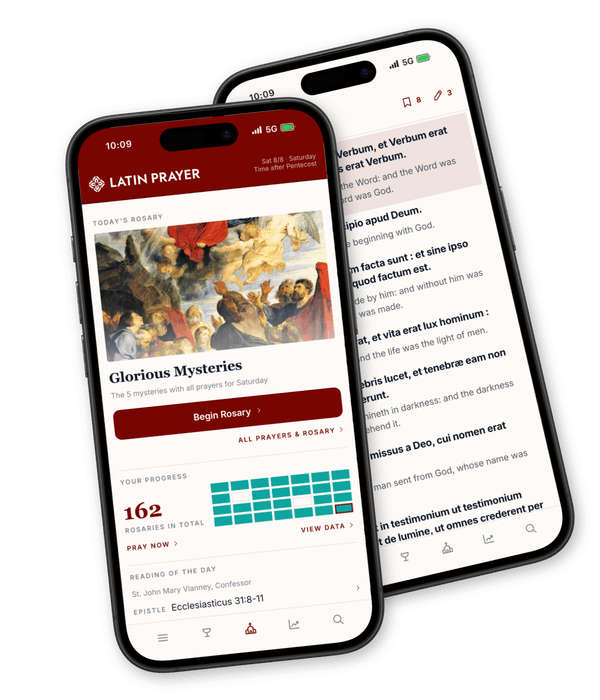
Latin Prayer: my app for praying in Latin
The Rosary, the Mass, the Vulgate and the prayers of the Church — Latin and English side by side, line by line, much of it with audio, so you can hear how it sounds. Free, no ads, for iPhone and Android.
Email digest
When there’s a new post, you’ll get a short email — at most once a day. Free, and you can unsubscribe anytime.
Der Essay It is not even very complicated von Dushan Wegner ist auch online zu lesen: https://www.dushanwegner.com/essays/it-is-not-even-very-complicated/, und auf dushanwegner.com finden sich noch viele weitere Texte, Bücher und sogar T-Shirts zum Thema!
