

A dear person, in conversation with me, put forward the thesis that churches are not needed to encounter God. One could also go into nature for that, experience the sublime there.
I objected by mentioning the philosophy of language known to both of us, according to which a person can only think about that for which they have a concept. How do you know that it is a God you think you are encountering?
I was and am truly not against approaching the Higher in nature. Many a monastery and many a seminary are built in the mountains for good reason, many a saint was formed in sublime seclusion.
Judaism has a blessing ready for many occasions, and I sometimes wonder what the appropriate blessing would be in each case. The blessing at the sight of sublime nature is „oseh ma’aseh bereishit,“ and in full it translates as: „Blessed are You, Lord our God, King of the Universe, who performs the work of creation.“
What I translate here as creation literally means work of the beginning, which of course recalls the unmoved mover of Aristotle and the corresponding proof of God. Such are the thoughts and concepts that a person understands at the sight of the sublime – if and because they have previously learned them in church and study.
The divine that you experience in nature without church is of course by no means worthless! But your conceptless recognition resembles the gurgling of a baby delighting in a funny sound.
When I Was a Child
Saint Paul explains:
When I was a child, I spoke as a child, I understood as a child, I thought as a child: but when I became a man, I put away childish things.
The „adult“ concepts for the divine are learned by humans in church. The doctrine in its ramifications is the difference between the babbling enthusiast and the holy mystic.
We Should Both Test
That, then, was the direction of my argument, but all theory is gray. We should and wanted to test both our theses on that past Sunday.
First we attended the Old Mass.
This person, who understands Latin far better than I do (but acts as if it means nothing), remained distant but remarkably polite.
After the threefold Miserere Nobis, back on the street, that person claimed their reddened eyes came not from emotional stirring but from the incense. (However, no incense was used yesterday, so I interpret this metaphorically and thus as true.)
After refreshment in cheerful company, we got in the car and drove to the nearby mountains to test the counter-thesis.
No Contour, No Form
Our destination was a viewing platform from which every person receives an overwhelming view into the valley in the sense discussed.
So I believe at least.
I must believe that it is so.
Because: Already during the drive through an enchanting fairy-tale forest, over serpentines and under tree canopies that jutted over the road, it became foggier with every meter of altitude.
When we finally arrived at the platform, where the sublime was to demonstrate to me the churchless experience of God, we stood in bright gray, luminous nothingness.
Oh, how shamelessly I laughed!
The image above this essay is my unedited original photo.
We see behind the railing: Nothing. Nothing at all. (Only a few spots where the light penetrated through the fog, which I only saw later when I looked at the photos.)
What symbolism!
What a practical parable!
Without revealed and transmitted concepts of the divine, humans stare into foggy nothingness. The nothingness glowed, the sun was shining into it. But no contour could be recognized, no form.
Nothing, really nothing tangible at all.
We drove cheerfully back down into the valley. I thanked heaven for this illustration of the absence of concepts.
„In the beginning was the Word,“ we had read in the morning, and it is true. Humans do well to learn some of the names and concepts in which the Word has been handed down to us.
Weiterschreiben, Wegner!
Das Schreiben dieser Essays ist nur mit Ihrer Unterstützung möglich. Werden und bleiben Sie Teil meiner Arbeit!
Bitte wählen Sie Ihren freiwilligen Leserbeitrag:
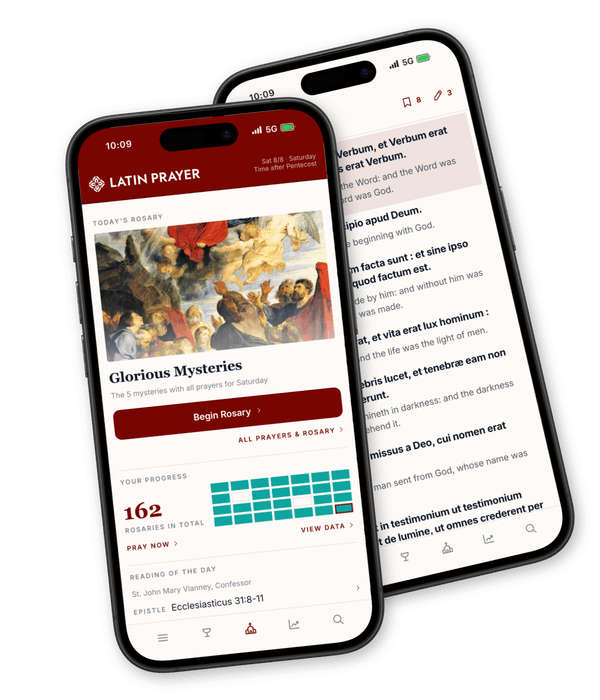
Latin Prayer: my app for praying in Latin
The Rosary, the Mass, the Vulgate and the prayers of the Church — Latin and English side by side, line by line, much of it with audio, so you can hear how it sounds. Free, no ads, for iPhone and Android.
Email digest
When there’s a new post, you’ll get a short email — at most once a day. Free, and you can unsubscribe anytime.
Der Essay Without a Concept, Just »Oh!« von Dushan Wegner ist auch online zu lesen: https://www.dushanwegner.com/essays/without-a-concept-just-oh/, und auf dushanwegner.com finden sich noch viele weitere Texte, Bücher und sogar T-Shirts zum Thema!
