
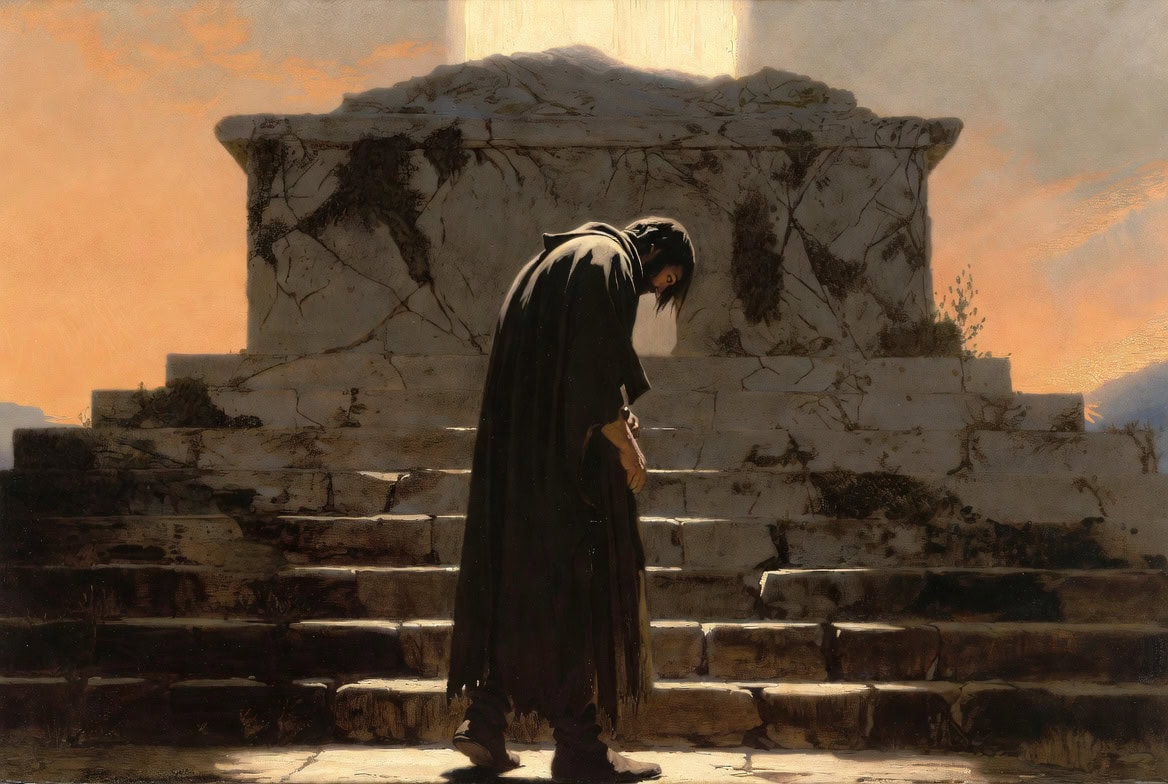
Right up front, transparently and honestly: today I am writing about my interpretation, my feeling at this intersection of space and time. It is a report from the inside, about a … ah, let’s go in!
It is a simple sentence, four short words: Introíbo ad altáre Dei.
What follows is my thesis: the decline of the West can be traced through these four simple words. More precisely: through their absence, and the resulting loss of their effect.
The West is tired and confused, and its people are breaking down. And it has a great deal to do with these four words. But not everything is lost — let me explain!
I Go In
»Introíbo ad altáre Dei« literally means something like: I go in to the altar of God.
It is drawn from Psalm 42. And it is spoken in the Prayers at the Foot of the Altar of the Old Mass.
»The Introibo« was fixed in 1570 in the liturgy of Pius V — and in 1965 it was cut out again by Annibale Bugnini (see Wikipedia). Which is to say, right around the point when things started going rapidly downhill for the West.
It is easy to defend the claim that most of what (still) works in and about the world was developed in Christian times and places. By Christian we mean Catholic, and when a Catholic Mass appears in film, it is usually one in which the Introibo is still said. That remains, to this day, the prototype of church.
At the Foot of the Cross
On the Catholic understanding, the Mass is (metaphysically) identical to the sacrifice of the Cross. Whoever takes part in the Mass stands at the foot of the Cross on Golgotha. (Which explains why people, back when they still knew and believed this, put on their Sunday best.)
But the sacrifice of the Cross is the fulfillment of the sacrificial rituals by which the priests of the Old Testament pointed toward this greatest and final offering. The sacrificial lamb, though, is at the same time the high priest — in the Mass represented by the priest of flesh and blood, while bread and wine become the flesh and blood of the Lamb.
Just as the priest of the Old Testament prepared himself inwardly for the sacrificial act, the opening verses and psalms prepare the priest for the sacrificial act, and so for the Eucharist.
Our Attention, Too
The priest stands (in the Old Mass) facing forward, looking toward the Cross and toward the east, toward death and toward the resurrection: ad orientem. He performs the sacrifice that is, precisely, offered for us as well.
»I approach the altar of God,« says the priest in preparing the sacrament, and he does it in our place. The sacrament (a sign-act with real effect) requires, alongside form and matter, also the right intention of the one performing it.
When the priest becomes aware, in words, that he stands before the altar, this also gathers our attention and intention.
Yes, yes, a sacrament can be valid even when attention and intention falter somewhat, or were only present at an earlier point (extreme unction) — but you will experience the greatest perceptible blessing when you, with »thy whole heart, thy whole soul, all thy strength, and thy whole mind« — together with the priest — are oriented forward, toward »the altar« itself.
We Don’t Practice It
Introíbo ad altáre Dei — I will approach the altar of the Lord. We once trained ourselves in this: standing at the foot of the altar, and then going in. We no longer practice it — and the results are terribly tangible.
A society in which, at times, not even the priests perceive themselves as standing »at the altar of the Lord« is simply a society far from the altar of the Lord.
People have stepped back from the altar, the memory was cut out of the liturgy for them — and when things really went badly, what they got instead was chickens in diapers and LGBTQ-themed Masses.
It’s all so exhausting, and it could well suit malicious forces that it is exhausting and confusing and sad. A confused, tired, restless, godless society is easier to steer, easier to lead by a (sometimes literal) ring through the nose, through the circus ring of their age.
So where is new strength meant to come from — new youth, new freshness?
The Joy of My Exultation
Now, the liturgy, quoting Psalm 42:4 from the Vulgata Clementina, has us answer the priest: »ad Deum qui lætificat juventutem meam«.
Literally, that means something like: »To God, who makes my youth joyful.«
Yes, we remind the priest — whether he is 28 or 82 — that the God, at whose altar he stands, precisely there and then awakens anew his strength and youth.
In place of juventutem, the original Hebrew has שִׂמְחַת גִּילִי (simchat gili), which literally means »the joy of my exultation«.
We feel it in our bones, when we stop and are honest; we miss both — the joy of our exultation as much as the strength of our youth. We miss them each on our own, and we miss them all together.
So what is to be done?
Well, our fathers knew a way, and I hear it still leads to its destination (so reliably, in fact, that certain authorities want to block and forbid it): Introíbo ad altáre Dei.
Keep writing, Wegner!
Writing these essays is only possible with your support. Become and stay part of my work!
Please choose your voluntary reader contribution:
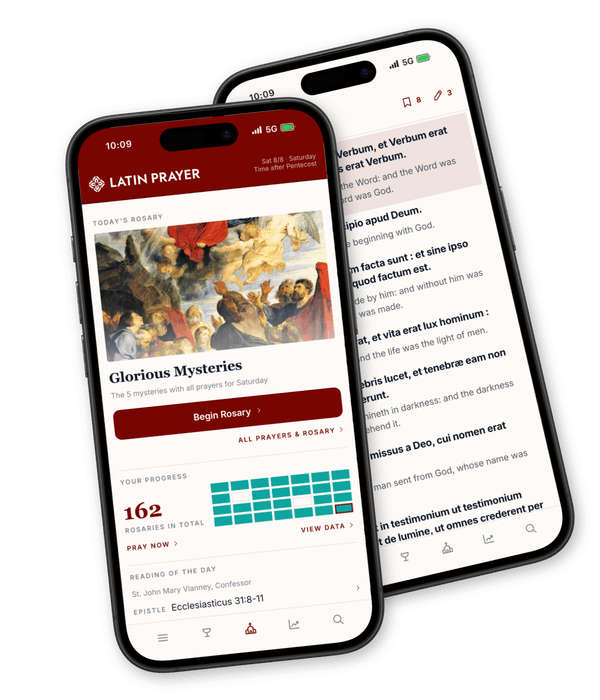
Latin Prayer: my app for praying in Latin
The Rosary, the Mass, the Vulgate and the prayers of the Church — Latin and English side by side, line by line, much of it with audio, so you can hear how it sounds. Free, no ads, for iPhone and Android.
Email Notification
When there’s a new post, you’ll get a short email — at most once a day. Free, and you can unsubscribe anytime.
Der Essay Introíbo ad altáre Dei von Dushan Wegner ist auch online zu lesen: https://www.dushanwegner.com/essays/introibo-ad-altare-dei-english/, und auf dushanwegner.com finden sich noch viele weitere Texte, Bücher und sogar T-Shirts zum Thema!
