

If wisdom were measured by the number of books a person intended to read, I would count among the wisest of the wise.
It’s not for lack of intention or good will! It’s my unruly brain that wants to jump here and there, that is “interested” in this and that. So I can call who-knows-how-many half-read books my own. One day, as soon as humanity stops producing new books, I’ll breathe freely and read through all the books I’ve planned.
(Did I say I own the books? Ah, that’s only partly true. I confess, I too have succumbed to the comfort of the Kindle, those electronic books from Amazon, and there the books are more rented than owned. Yes, yes—comfort lures us into foolish things.)
Of course, in polite small talk I don’t say that I’ve started but not finished this or that many books—in other words, that I’ve failed. I don’t say it about the books I’ve read, nor about the ones I’ve written.
As long as I haven’t admitted defeat, I can say: I’m reading (or writing) several books in parallel.
In that sense, it’s true: at any given time, I’m reading several books in parallel. Some time ago, this parallelism gave me an experience that was first surreal and then illuminating!
At the time, I was reading, among others, a Johann Sebastian Bach biography (Music in the Castle of Heaven) and one of those fantasy novels my daughter was recommending to me then (something by Brandon Sanderson, if I recall correctly).
Both books contain passages describing political developments. Yet one is a biographical history book, the other a fantasy novel for young readers.
One day, reading these books “in parallel,” I picked up my e-reader, and the last-read page appeared automatically.
So I continued reading without hesitation, amused by the fantastic descriptions of fantasy politics in Mr. Sanderson’s imaginary world… until suddenly the Bach family was mentioned.
For a split second my brain thought: “Oh, what a funny coincidence that in this supernatural fantasy world there’s also someone named Bach, just like the family of musicians.”
Then my brain finally realized and corrected itself: I had actually been reading the history book, but my brain thought it was the fantasy novel—so it interpreted the historical events as wildly imagined fantasy.
And so now
These days and years, I am not alone in feeling that the great matters simply make no sense. Whatever the true story is of which we are a part, I feel as if I can’t even properly classify the genre.
What interpretive framework do you apply to so-called reality?
A conspiracy theorist might say “the people with the little hat” are to blame for everything. A communist says it’s capitalism behind it all. A capitalist says it’s the communists. And so on.
A Christian will (and should) even perceive a metaphysical layer in the world and interpret events from that other level.
But what are the criteria by which one could decide what the correct level of interpretation is? Can such criteria even exist if they must lie “outside” all the other interpretive levels?
Which interpretive level do I apply to events—and by what justification?
Ah yes, I sigh, and I reflect:
Of making many books there is no end, and much study is a weariness of the flesh. (Ecclesiastes 12:12b)
It is Sunday morning. Today should be a day of refreshment, not of continued weariness.
And yet my day begins with a bus ride, to visit my daughter. We will go to church there today.
For the bus ride, I pack my Kindle, the e-reader with its countable yet uncounted half-read books (among a few that I’ve finished more than once). Will I be able to decide what to read along the way?
I’m still practicing the Apostles’ Creed in Latin. I have that on the Kindle too, of course. But the challenge there lies less in finishing than in reflecting and internalizing (and learning by heart).
To begin is good. To finish is better.
But the meaning of the reading exercise lies in reflecting and internalizing—whatever book you happen to be reading. (And whatever other book you might mistake it for.)
Weiterschreiben, Wegner!
Das Schreiben dieser Essays ist nur mit Ihrer Unterstützung möglich. Werden und bleiben Sie Teil meiner Arbeit!
Bitte wählen Sie Ihren freiwilligen Leserbeitrag:
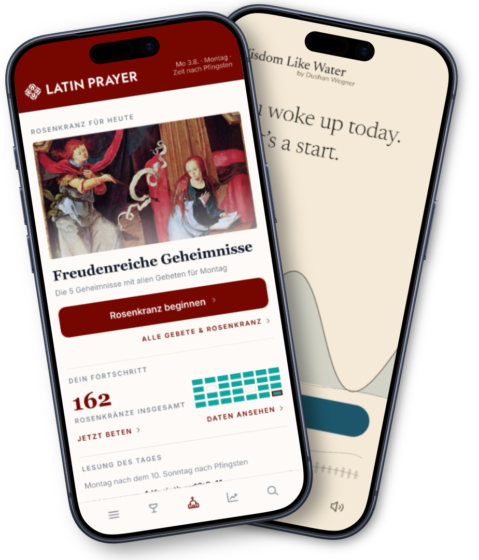
Beta: test my apps early
I’m looking for readers who test new versions of my apps before release — on Android and on iPhone. One group for both, free and no strings attached.
Email digest
When there’s a new post, you’ll get a short email — at most once a day. Free, and you can unsubscribe anytime.
Der Essay A book I thought was a different one von Dushan Wegner ist auch online zu lesen: https://www.dushanwegner.com/essays/a-book-i-thought-was-a-different-one/, und auf dushanwegner.com finden sich noch viele weitere Texte, Bücher und sogar T-Shirts zum Thema!
