

„‚Tis better to have loved and lost than never to have loved at all,“ thus wrote Lord Tennyson in memory of his friend.
One weary of love may answer: Oh, who cares? Without the object of my love, love is meaningless. And when I am no more, my love dies too.
„When hatred with his package comes, you forbid delivery,“ so sings Leonard Cohen. The hater participates in hatred, he accepts delivery, he makes it his own.
It is similar with love. The lover accepts love, gives it direction and object. Lovers accept love and settle into it. Man needs love, else he grows cold. But love exists even without man, similar to how God, the universe, or the number three exist without man.
What about love of homeland?
Is it better to have loved and lost a homeland than never to have felt homeland?
„No, no, no,“ cry the upright, „never give up one’s homeland! Fight, to the last!“
One weary answers: „When I am no more, my homeland loses me anyway. Either way. So it is only a question of what comes first.“
But the gentle reader notes: „Homeland does not die. The state may turn against its citizens. The land may be occupied by enemies. Our children may be scattered to all winds, married to strangers or not born at all. But homeland cannot die. For: homeland and love of homeland are the same, and love does not die.“
As answer, then: „Yes, it is better to have loved and lost than never to have possessed. The land may die, the friends may be buried, the object of your love may go the way of all temporal things. But as Paul rightly says: Faith, hope, and love remain, but love is the greatest among them. (1 Corinthians 13:8-13)“
Is it then better to have loved and lost? Yes, it is.
Homeland remains, not only until the last, for homeland like love has no last. Ask the expelled! The expelled lost their cities, and in their houses strangers now live. Yet the love of homeland, and thus homeland itself, did not die—because love cannot die.
But where we speak of the expelled: In the catacombs of Rome, above the skulls and shinbones of the monks, and not only there, one reads: What you are today, we once were too. And what we are today, you will soon be.
Weiterschreiben, Wegner!
Das Schreiben dieser Essays ist nur mit Ihrer Unterstützung möglich. Werden und bleiben Sie Teil meiner Arbeit!
Bitte wählen Sie Ihren freiwilligen Leserbeitrag:
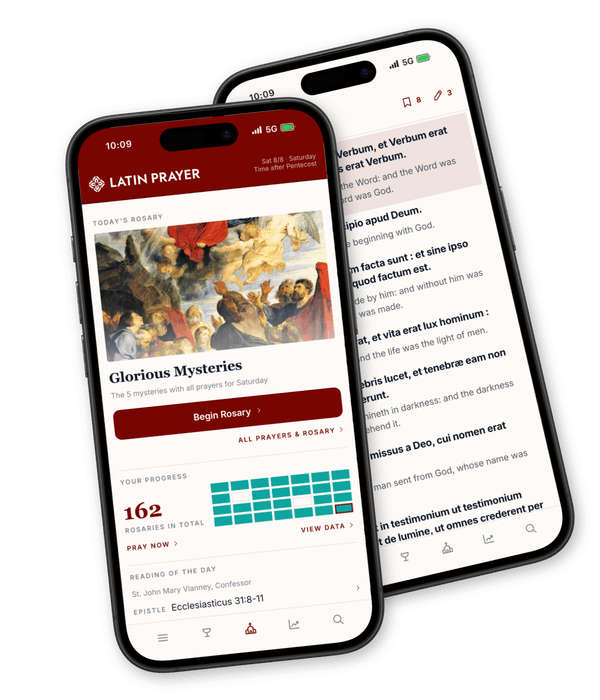
Latin Prayer: my app for praying in Latin
The Rosary, the Mass, the Vulgate and the prayers of the Church — Latin and English side by side, line by line, much of it with audio, so you can hear how it sounds. Free, no ads, for iPhone and Android.
Email digest
When there’s a new post, you’ll get a short email — at most once a day. Free, and you can unsubscribe anytime.
Der Essay And what we are today von Dushan Wegner ist auch online zu lesen: https://www.dushanwegner.com/essays/and-what-we-are-today/, und auf dushanwegner.com finden sich noch viele weitere Texte, Bücher und sogar T-Shirts zum Thema!
