

The bad news is that no one here gets out without wounds. The good news is that for some, this will be a literal blessing. – Let me explain!
Attentive readers, who enjoy thinking but unfortunately only have cursory Bible knowledge, noticed in yesterday’s essay something that looked like a mistake on my part.
I wrote about Joseph, the son of Jacob. And then I quoted the Bible, where the father Israel loved this Joseph „more than all his sons.“ And this Israel had „a colorful robe made“ for Joseph.
So, who and what are we talking about? About Jacob or about Israel?
The answer can be found in a vivid scene that I’ve been thinking about again and again in recent days. You can find it described in Genesis 32:25–31.
The very brief backstory: Jacob wanted to appease his brother Esau, so he set out to meet him, including his herds, his children, and his two wives. When they had to cross the river, he sent them all ahead, along with all his possessions, and stayed behind alone.
Hard Cut
We do not know Jacob’s motivation for staying behind alone, but we do know the higher purpose.
The biblical account here uses what one would call a hard cut in film. One thing is happening, and suddenly, something else occurs:
He took them and sent them across the river. Then he sent over all his possessions. So Jacob was left alone, and a man wrestled with him till daybreak. (Genesis 32:24-25)
The two wrestle. During the struggle, Jacob is struck on the hip by the man, and from then on, Jacob’s hip is dislocated. And yet, Jacob becomes the victor.
If you don’t
Towards morning, that man seems to give up, and he says to Jacob: „Let me go, for the dawn has come!“
But Jacob replies: „I will not let you go unless you bless me.“
As if this were a normal, expected demand in such a situation, the mysterious fighter asks a clarifying question: „What is your name?“
„Jacob,“ Jacob answers.
Then the one from the night, also explaining himself, says: „You will no longer be called Jacob, but Israel—God’s fighter—for you have struggled with God and with humans and have prevailed.“
For higher and deeper truth
This explains how Joseph can be the son of Jacob, but his father Israel gives him a wonderful colorful coat.
But what does the famous nighttime scene mean?
The scene begins with Jacob being alone. We humans really don’t cope well with loneliness. The problem is that seclusion and being alone are at the same time prerequisites for finding higher and deeper truth—in other words: God.
Jacob’s nighttime struggle, however, can be read as a symbol for prayer. Not the important, but still stress-free prayer before a meal. („Lord, bless us and these gifts, which we receive from your goodness …“)
Rather, it is the prayer of the desperate, whose children have not had truly nourishing food for three days. Or the wrestling with meaning and existence of the believer who was already internally lonely before entering outer solitude.
That ominous nighttime opponent was God in the form of an angel. And God actually allowed Jacob to set a condition under which Jacob would break off his „prayer“ for the moment: „I will not let you go unless you bless me.“
To use a modern word
The blessing of God, however, begins with Jacob receiving a new name, which according to these verses stands for „God’s fighter.“
Jacob receives a new name. He is now Israel. (Which does not mean that he is no longer Jacob. To use a modern word, he receives a new identity—and unlike the leisure identities of today, this identity is actually metaphysical.)
In the struggle for inner peace, life will give you a wound—a hip injury. Yes, often enough it is evil or blind people who strike us „on the hip.“ But it is not a punishment, it is a sign. Your wounds and scars are memorials on your body—or on your soul.
Yes, we are those who do not see shame in weakness, in wounds, or in inferiority.
„When you meet those who disbelieve, strike [their] necks; and when you have finally subdued them, bind their fetters tightly,“ it says in Surah 47:4—Paul writes: „That is why I delight in weaknesses, in insults, in hardships, in persecutions, in difficulties. For when I am weak, then I am strong.“ (2 Corinthians 12:10b).
Hip injury and the reckoning
But notice the matter-of-factness with which Jacob accepts the hip injury and has only one concern: to be blessed.
The story of Jacob’s night-time struggle on the banks of the Jabbok contains a lesson for everyone, not just for believers!
Indeed, anyone who does not wrestle with „God“ will inevitably struggle, wrestle, and fight with fate. And at times, they will feel just as alone. Some of them will end up with a hip injury.
But apart from the hip injury and the bill from the psychotherapist or the local pub, they will gain little from their struggle with fate. No blessing, not even a good story.
Perhaps just a limp.
Weiterschreiben, Wegner!
Das Schreiben dieser Essays ist nur mit Ihrer Unterstützung möglich. Werden und bleiben Sie Teil meiner Arbeit!
Bitte wählen Sie Ihren freiwilligen Leserbeitrag:
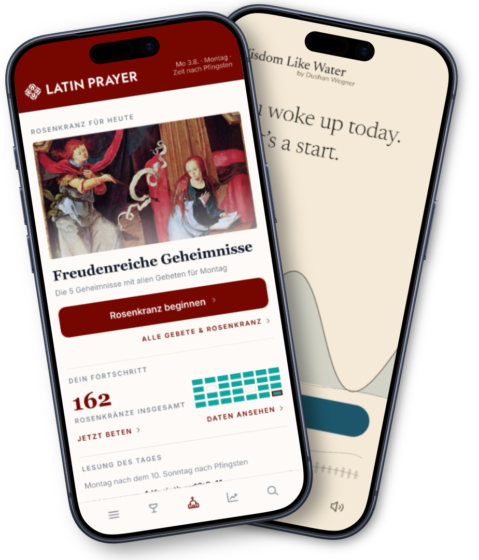
Beta: test my apps early
I’m looking for readers who test new versions of my apps before release — on Android and on iPhone. One group for both, free and no strings attached.
Email digest
When there’s a new post, you’ll get a short email — at most once a day. Free, and you can unsubscribe anytime.
Der Essay No one leaves unscathed von Dushan Wegner ist auch online zu lesen: https://www.dushanwegner.com/essays/no-one-leaves-unscathed/, und auf dushanwegner.com finden sich noch viele weitere Texte, Bücher und sogar T-Shirts zum Thema!
