

A footballer scores a goal, and if he happens to be Southern European or South American, it may well be that he makes the sign of the cross and sends a word of thanks heavenward.
Why, though?
What does it mean?
We can surely manage, even without daily practice, to recite the accompanying words: »In nómine Patris, et Fílii, et Spíritus Sancti.«
We speak them at Mass, at the very beginning, in the Praeparatio: »In nómine Patris, et Fílii, et Spíritus Sancti. Amen.«
Translated, that is: »In the name of the Father and of the Son and of the Holy Ghost.«
We notice the singular, of course, in the command to baptize. In the name, not in the names. One name, three Persons. The keyword, naturally, is the Trinity – a vast subject I only brush against today. I am speaking about the ordering that comes before it.
A Formula as a Home
What does »in the name« actually mean?
No doubt it sounds beautiful to say. We have heard it so often that it feels familiar. A formula as a home. But why do we not say, for instance, »in the presence of« or »We praise«?
»In the name« is (here) first a matter of belonging and authority, and Acts 4:7 lets us feel what it meant back then.
In the previous chapter the apostles Peter and John had healed a lame man and, with it, preached the forgiveness of sins and the message of Jesus Christ.
The next day they are asked by the Jewish leaders: »By what power or by what name, have you done this?«
It is a question about authority, and they answer:
Be it known to you all and to all the people of Israel, that by the name of our Lord Jesus Christ of Nazareth, whom you crucified, whom God hath raised from the dead, even by him, this man standeth here before you, whole.
The rulers grasp the power of this name, and so »that it may be no farther spread among the people« they wished to »threaten them that they speak no more in this name to any man.« (Acts 4:17)
It was not the apostles the powerful feared, but the one in whose name they acted.
Obeying, But Out of Love
The Christian, whether adult or child, is baptized into the name of the Father, of the Son, and of the Holy Ghost. The same name, but a different function: into.
In the name means authority and commission, ever anew, but into the name means adoption – baptized to be child and son.
Paul is plain here, almost blunt:
And because you are sons, God hath sent the Spirit of his Son into your hearts, crying: Abba, Father. Therefore now he is not a servant, but a son. And if a son, an heir also through God.
We act and live in the name, that is, with the authority of the Trinity. But »merely« to act with authority – a servant or even slave can do that too. Servant and slave obey because they must obey, and they remain strangers in their master’s house.
The son too obeys, provided he is a decent son and the father’s commands are fitting, but he obeys out of love and belonging – and the father leaves him the house as his inheritance, for the same reasons.
In the name means commission, and into the name means sonship rather than bondage, in the spirit of Romans 8:15: »For you have not received the spirit of bondage again in fear; but you have received the spirit of adoption of sons, whereby we cry: Abba (Father).«
Not by the Formula Alone
The footballer in his moment of joy – the ordinary man suddenly standing helpless before some danger – the other man giving thanks for his evening meal – none of them, in making the sign of the cross, performs a gesture of submission. He affirms a belonging older than his own understanding: I belong in this house, whether I grasp it at this moment or not.
Some people suspect that the sign of the cross »works even when you don’t believe in it« – but actually that cannot be so!
Considered theologically, the sign of the cross together with its words is a sacramental (like grace before meals or a blessing), not a sacrament (like baptism or Extreme Unction). The effect of the sign of the cross depends on the disposition of the one who makes it, not on the formula alone.
And yet it does seem, at times, to work even then – »when you don’t believe in it«! Why?
Well, it may be that people, in their soul, know of its efficacy and even feel it, but – for one reason or another – will not admit it.
Left Shoulder to Right Shoulder
Let us simply try it, whether in secret or in the open. It is meant to do good, and it will certainly do no harm.
First: join thumb, index finger, and middle finger of the right hand to a point (for the Trinity), the ring finger and little finger folded into the palm (for the two natures of Jesus).
And then: In nomine Patris (touch the forehead), et Filii (the breastbone), et Spiritus Sancti (left shoulder to right shoulder).
And finally (hands folded, or in the Spanish-speaking world thumb and index finger already formed into a cross and kissed): Amen.
Keep writing, Wegner!
Writing these essays is only possible with your support. Become and stay part of my work!
Please choose your voluntary reader contribution:
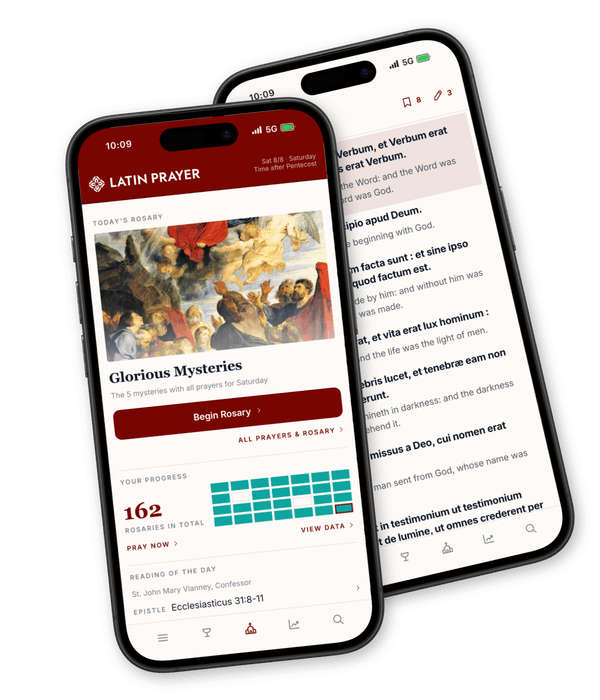
Latin Prayer: my app for praying in Latin
The Rosary, the Mass, the Vulgate and the prayers of the Church — Latin and English side by side, line by line, much of it with audio, so you can hear how it sounds. Free, no ads, for iPhone and Android.
Email Notification
When there’s a new post, you’ll get a short email — at most once a day. Free, and you can unsubscribe anytime.
Der Essay By what power or by what name von Dushan Wegner ist auch online zu lesen: https://www.dushanwegner.com/essays/by-what-power-or-by-what-name/, und auf dushanwegner.com finden sich noch viele weitere Texte, Bücher und sogar T-Shirts zum Thema!
